Jun 21, 2026
Deep-Space Exploration Probe: An Autonomous Scientist Beyond Earth
This article describes an original fictional spacecraft concept using only general, publicly known principles of planetary science and space engineering. It contains no classified information or controlled unclassified information.
A deep-space exploration probe is a robotic spacecraft designed to travel far beyond Earth and investigate planets, moons, asteroids, comets, and the space between them. Unlike an Earth-orbiting satellite, the probe may spend years traveling through regions where sunlight is weak, temperatures are extreme, radiation is intense, and communication with mission control is delayed or temporarily unavailable.
The probe’s most important quality is independence. It must function as a scientific laboratory, navigator, communications station, and self-protecting machine. When Earth cannot provide immediate instructions, the spacecraft must continue collecting information, managing its power, checking its own health, and responding safely to unexpected conditions.
The Spacecraft Body
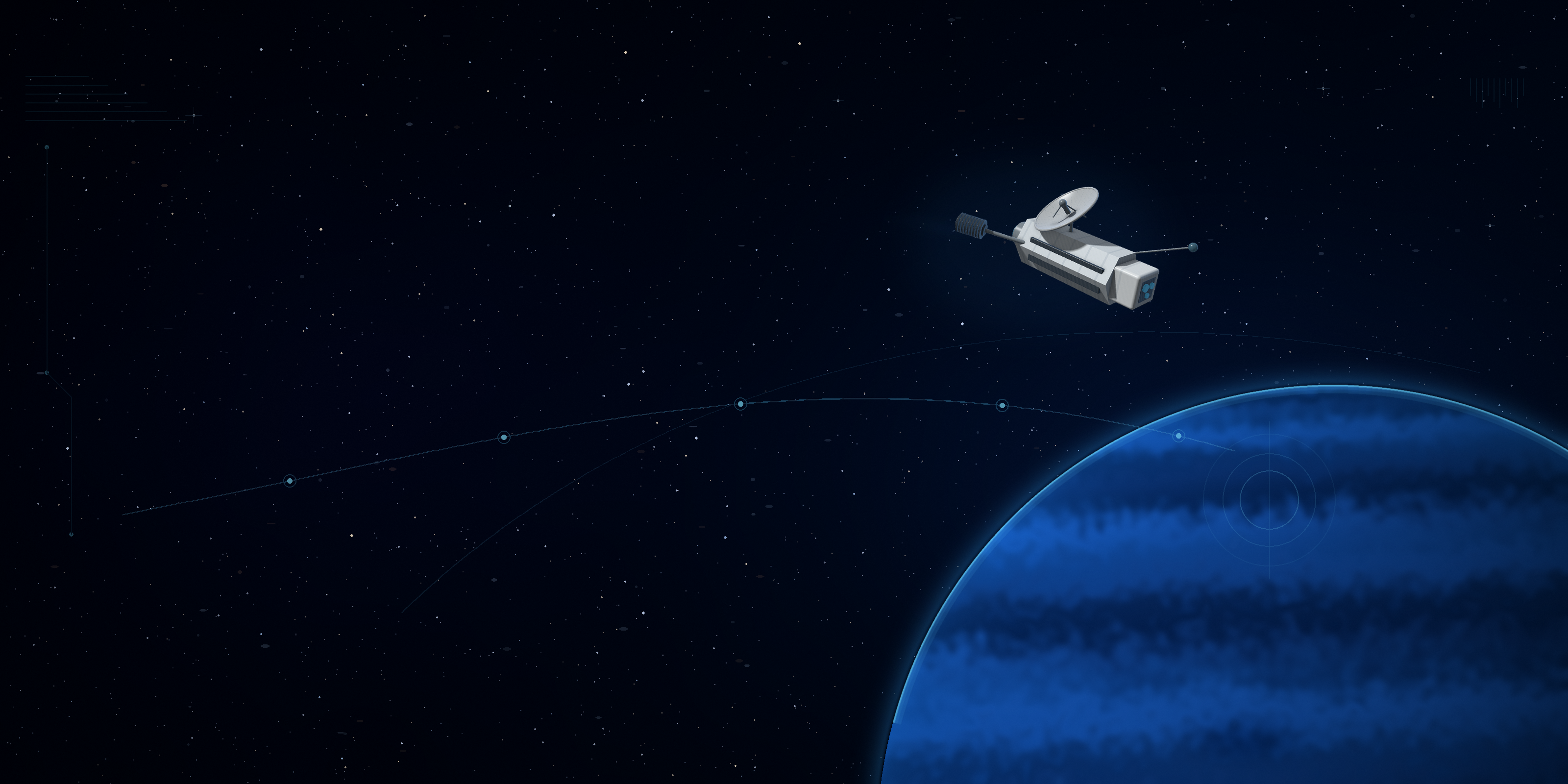
The main body of the probe is known as the spacecraft bus. It is the structural frame that holds the computers, scientific instruments, power equipment, propulsion hardware, communications systems, and thermal-control components.
For this concept, the exterior would use white ceramic panels, dark graphite-colored surfaces, and exposed metallic structures. These materials would give the probe a clean, futuristic appearance without relying on the large areas of gold-colored insulation often seen on traditional spacecraft.
Inside the body, important equipment would be divided into protected compartments. Sensitive electronics would be shielded from temperature changes, radiation, launch vibration, and small particle impacts. The structure would also provide firm mounting points for cameras, antennas, sensors, propulsion units, and instrument booms.
Onboard Computers
The probe would contain more than one flight computer. A primary computer would manage routine operations, while a backup computer would remain available if the main system developed a problem.
These computers would control the spacecraft’s orientation, instrument schedules, power use, communications, navigation, data storage, and fault protection. They would also interpret information from hundreds of internal sensors that monitor temperatures, voltages, currents, fuel levels, mechanical movement, and computer performance.
The probe’s software would operate under carefully defined rules. It would not make unrestricted decisions. Instead, engineers would provide approved responses for situations such as low power, excessive heat, unexpected radiation, navigation errors, or loss of communication.
Long-Duration Power
Solar panels are useful near Earth and Mars, but sunlight becomes much weaker in the outer solar system. A probe traveling toward Jupiter, Saturn, Uranus, Neptune, or the Kuiper Belt may need a power source that can operate far from the Sun.
This concept would use long-duration radioisotope-style power units. Such units could provide steady electricity and heat for the spacecraft’s electronics and instruments. The design would also include batteries to support brief periods of high power demand, such as communications sessions or scientific observations.
Power would be carefully budgeted. During quiet portions of the journey, nonessential instruments could be turned off or placed in low-energy states. Before a planetary encounter, the spacecraft could gradually activate cameras, sensors, navigation systems, and data recorders.
Thermal Control
Deep space is extremely cold, but spacecraft electronics also generate heat. The probe must balance both conditions.
Insulation would slow the loss of heat from the spacecraft’s interior. Small electric heaters would protect instruments, batteries, propulsion lines, and computers from becoming too cold. Radiators would release excess heat when equipment was operating at higher power.
Temperature sensors throughout the spacecraft would allow the flight computer to monitor each major compartment. If an instrument became too cold, the computer could activate a heater. If a system became too warm, the probe could reduce its activity or change its orientation.
Communications with Earth
A large high-gain dish antenna would provide the probe’s main connection with Earth. Smaller antennas would support emergency communication when the main dish could not be pointed accurately.
Because radio signals travel at the speed of light, messages from a distant probe may require hours to reach Earth. A command sent in response may require several more hours to return. The spacecraft therefore cannot be controlled in real time.
Communication may also be interrupted when a planet, moon, or the Sun blocks the signal path. During those periods, the probe would store information in radiation-resistant memory. When the connection returned, it would transmit engineering reports, scientific measurements, and selected images.
The spacecraft could send small preview versions of images first. Scientists on Earth could then choose which full-resolution observations should receive priority.
Cameras and Spectrometers
The probe would carry several imaging systems. A wide-angle camera could photograph large areas of a planet, moon, ring system, or asteroid. A narrow-angle camera could examine craters, clouds, ice formations, cliffs, surface fractures, or possible plume activity in greater detail.
Infrared sensors could measure heat patterns and observe features that are difficult to see in visible light. Ultraviolet instruments could study atmospheric gases, auroras, and interactions between a world and the solar wind.
Spectrometers would separate light into different wavelengths. This information could help scientists identify water ice, minerals, organic compounds, atmospheric gases, and other materials on or around a planetary body.
Fields, Particles, and Dust
A magnetometer mounted on a long boom would measure magnetic fields while remaining separated from electrical interference produced by the spacecraft itself. These measurements could show how a planet’s magnetic field changes over time or how a moon interacts with the magnetic environment of a larger planet.
Particle and plasma instruments would measure electrons, ions, solar-wind particles, and high-energy radiation. This information would help scientists understand space weather, auroras, atmospheric loss, and radiation hazards.
A dust detector could record small particle impacts. By measuring their direction and energy, researchers could study dust around comets, asteroids, moons, and planetary ring systems.
Autonomous Navigation
Star trackers would photograph known star patterns and use them to determine the spacecraft’s orientation. Sun sensors and inertial measurement units would provide additional guidance.
As the probe approached a destination, navigation cameras could locate the planet or moon against the background stars. The onboard computer could compare the observed position with its predicted trajectory and identify whether a correction might be needed.
Small thrusters would rotate the spacecraft, point instruments, aim the communications antenna, and make limited trajectory adjustments. Reaction wheels could provide precise pointing during photography and scientific measurements.
Operating Without Communication
When the probe could not communicate with Earth, it would continue following a stored mission plan. It would check its power level, temperature, orientation, computer activity, instrument condition, and propulsion status.
If a serious problem occurred, the spacecraft could enter safe mode. Most scientific instruments would turn off, unnecessary activity would stop, and the probe would conserve power. It would stabilize its orientation, maintain safe temperatures, and attempt to point an antenna toward Earth.
The probe could also recognize unusual scientific events. A sudden dust impact, radiation increase, atmospheric storm, plume, or magnetic disturbance could trigger faster measurements. The computer might preserve data recorded before and after the event and mark it for priority transmission.
The Information It Would Return
The probe could produce maps, atmospheric profiles, surface-composition measurements, thermal images, radiation surveys, magnetic-field records, and information about dust and plasma.
Its observations might help scientists determine whether an icy moon contains an underground ocean, how a planet’s atmosphere escapes into space, how rings form and change, or what materials are present on an asteroid or comet.
Measurements collected between planets would also be valuable. The probe could study cosmic radiation, solar particles, magnetic disturbances, and interplanetary dust across regions that have rarely been observed directly.
A deep-space exploration probe would be more than a distant camera. It would be a resilient, autonomous scientific laboratory capable of navigating, observing, protecting itself, and preserving discoveries until communication with Earth became available again.